Panel participants, traditionally recruited qualitative respondents, and experienced researchers all participated in the same AI-moderated interview. They didn’t all arrive at the same conclusion.
TL;DR
A 166-session independent study evaluated AI-moderated interviews (AIMI) across three cohorts - panel participants, traditionally recruited qualitative respondents, and professional qualitative researchers.
Key finding: panelists produce results comparable to those of pure qual recruits in concept testing. Disclosure was high even on the sensitive topic of menopause. AIMI is most effective for validation tasks; human moderation remains superior for exploratory and emotionally complex research.
What was this study designed to test?
This is a within-AIMI study, not a comparison between AI-moderated and human-moderated formats. It asks three specific questions:
Does sample source affect the quality of data an AI-moderated interview produces?
Can panel participants generate insight comparable to traditionally recruited qualitative respondents?
How do professional qualitative researchers evaluate the AIMI experience when they complete it themselves?
The study was conducted independently by Lauren McCluskey of Responsive Research, Inc. Glaut provided the platform at no cost. All interpretations are the author's own.
Responsive Research Logo
How was the study designed?
Fieldwork: October 2025, completed in 3-4 days.
Format: 20-25 minute AI-moderated interview per participant, testing three menopause - reframing concepts.
Exposure design: Monadic - three concepts per participant, identical questions and probing logic throughout. Probing was set to ask maximum 2 follow ups to each question.
Five evaluation domains: Comfort & Disclosure, Interaction Quality, Depth of Response, Probe Effectiveness, and Analytical Usability.
Three cohorts:
Study design — three cohorts
01
Panel Participants
n = 101
$3 incentive
Women aged 40–60 across peri-, meno-, and post-menopausal stages. Recruited through the AI platform panel. Task-oriented, efficient, accustomed to structured digital interactions.
Participants
02
Pure Qual Recruits
n = 28
$30 incentive
Same demographic profile. Personally recruited via phone using traditional qualitative methods. Experienced with focus groups and IDIs. More expressive, reflective, and prone to spontaneous elaboration.
Participants
03
Qualitative Researchers
n = 37
No incentive
Experienced moderators from an insights community. Completed the interview themselves, then evaluated it professionally — assessing probing quality, conversational flow, and analytical usability.
Meta-evaluators
What were the main findings?
Finding 1: Panelists produce comparable directional results for tactical tasks
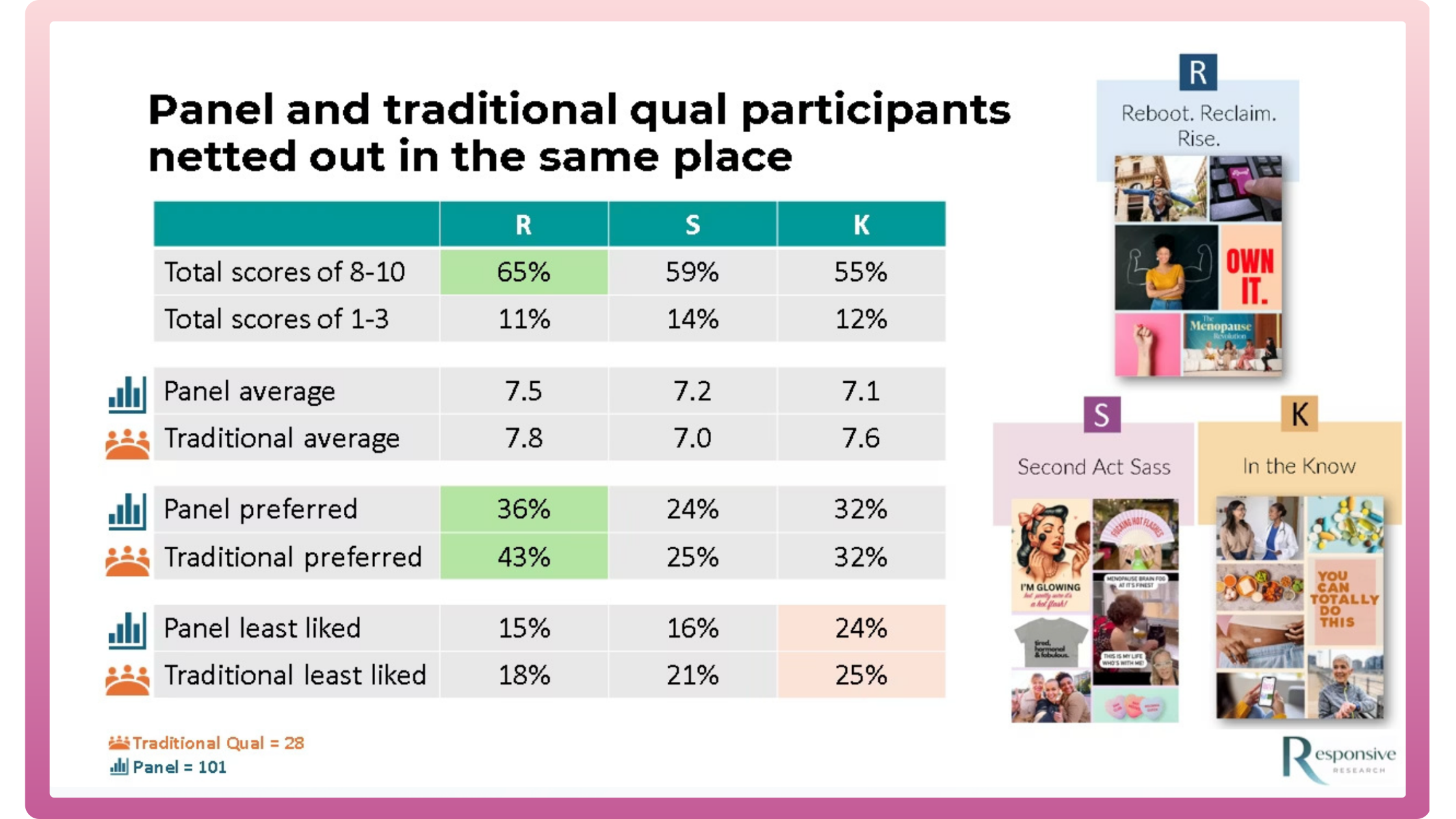
All three concepts performed similarly across both participant cohorts. Panel and Pure Qual participants converged on the same leading concept despite differing substantially in response style.
For validation-oriented objectives - concept testing, message testing, prioritizing options - panel recruitment delivers comparable directional insight to more resource-intensive traditional recruitment.
Finding 2: Disclosure was high on a sensitive topic, and that matters
Participants across both cohorts reported high levels of comfort, willingness to share personal experiences, and minimal concern about the absence of a human moderator. The topic was menopause: personal, health-related, emotionally loaded.
Achieving strong disclosure through AIMI on a topic this sensitive, without a human moderator building rapport, is a meaningful result for researchers evaluating AI moderation for qualitative work.
Finding 3: Sample source shapes insight quality even when outcomes align
Pure Qual recruits generated richer, more articulated, and more diagnostically useful responses - greater spontaneous elaboration, more narrative texture, and greater clarity about why concepts resonated.
The depth driver is participant articulation, not probe quality. This difference originates from participant orientation and incentive structure, not from the platform itself.
Source: p.10, Responsive Research report presented at QRCA (February 2026)
Finding 4: AIMI captures what participants offer, but it does not consistently unlock more
Probing maintained consistency and structure across the sample. It did not reliably elevate responses that were not already trending toward elaboration. This is partly explained by probing design, as AI moderator was instructed to follow up not more than 2 times.
When participants brought reflective input, the platform captured it effectively. When they did not, probing did not compensate. AIMI amplifies what participants bring; it does not substitute for what they lack.
Finding 5: Qualitative researchers rated AIMI useful for concept testing and identified where it falls short
Experienced moderators concluded that AIMI delivered comparable directional insight for concept testing. They also found that responses were shorter and less probing than human-led moderation of qual respondents would produce, limiting depth and emotional nuance.
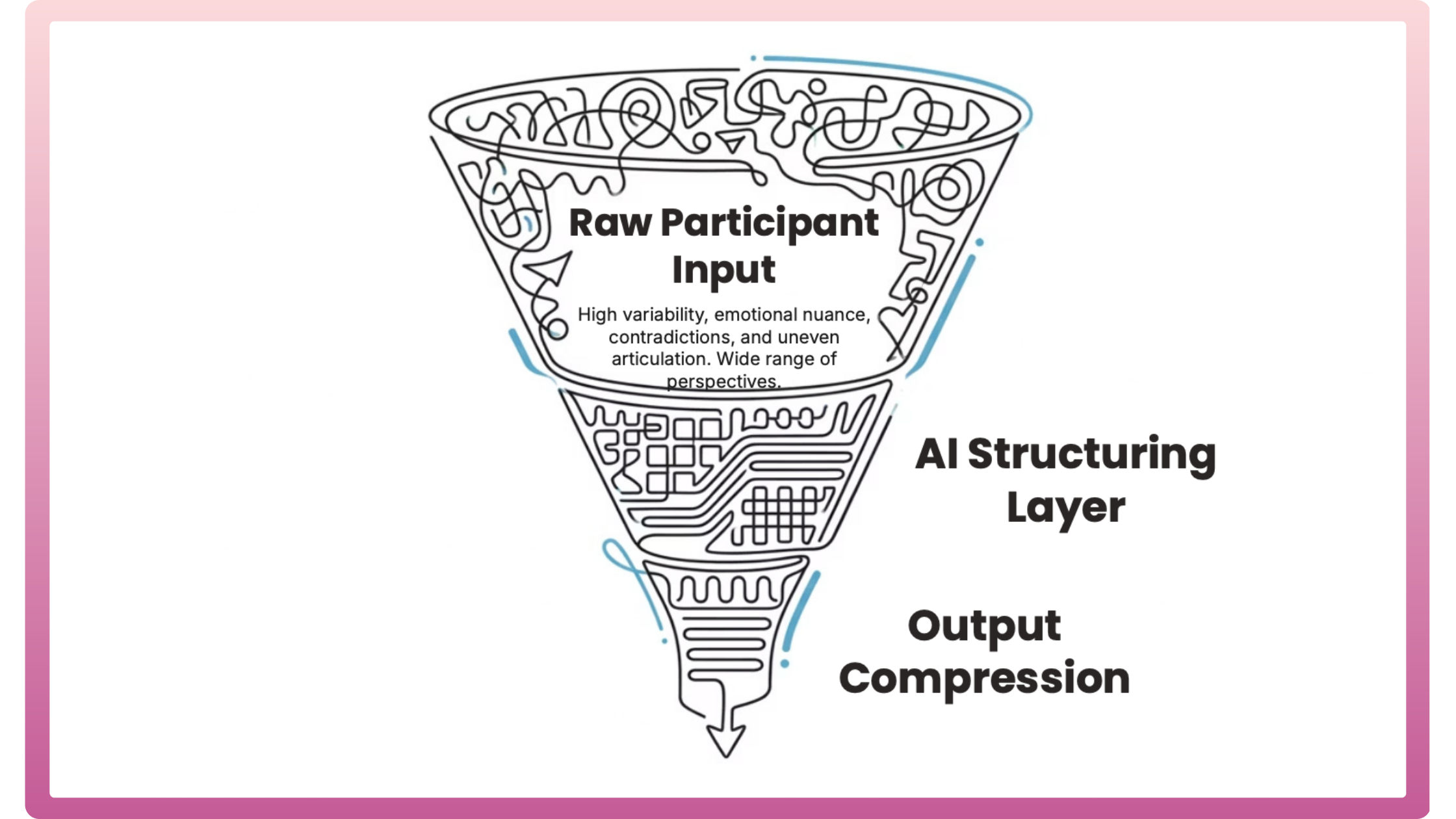
They identified what the report calls the "flattening effect": AI moderation's tendency to progressively reduce the variance and texture of participant input through standardized questioning, thematic clustering, and output generation. An active researcher's interpretation is the safeguard against it.
Source: p.13, Responsive Research report presented at QRCA (February 2026)
When should researchers use AIMI vs. human moderation?
Capability
AI Moderation
Human Moderation
Scale
High
Low
Speed
High
Moderate
Participant Comfort
High
High
Consistency
High
Moderate
Probing Depth
Moderate–Low
High
Emotional Insight
Moderate
High
Narrative Development
Low
High
Synthesis & Meaning-Making
Low
High
Use AIMI when the goal is validation:
Concept testing and message testing
Prioritizing options across a defined set
Early-stage directional feedback
Rapid pattern detection across large samples
Precursor to quantitative work
Screening to identify and handpick articulate participants for deeper qual
Use human moderation when the goal is discovery:
Deep exploratory research on complex or ambiguous topics
Strategic positioning and brand narrative work
Emotional journey mapping
Complex decision dynamics where empathy and rapport are central to the insight
What do researchers need to do differently when working with AIMI outputs?
Design for the sample, not just the platform. Pure Qual recruitment generates meaningfully better inputs when depth is the objective, regardless of the interview format.
Match the method to the objective. AIMI is fit-for-purpose for validation tasks. Deploying it for exploratory research can be risky.
Treat AI outputs as a starting point. AI-generated themes and summaries are an analytical input, not a final deliverable. Interrogating outputs and reconstructing compressed nuance is the core analytical task.
Recruit for the insight you need. When panel participants are sufficient, they are sufficient. When narrative depth and emotional texture are required, the recruitment strategy must reflect that.
Q&A from QRCA 2026
Can AIMI produce usable qualitative data on sensitive topics? Yes. This study found high disclosure and comfort levels among participants discussing menopause - a personal, emotionally loaded health topic - without a human moderator present. The absence of a human interviewer did not impose an emotional toll.
Do panel participants produce the same quality data as traditionally recruited qualitative respondents in AIMI? Directionally, yes - for concept testing and validation tasks. Both cohorts identified the same leading concept. The quality of insight behind those choices differed: Pure Qual participants produced richer, more diagnostically useful responses. Directional conclusions were comparable; depth of understanding was not equivalent.
What is the "flattening effect" in AI-moderated research? The flattening effect is the tendency of AI moderation to reduce the variance and texture of participant input as it passes through standardized questioning, thematic clustering, and output generation. The result is cleaner, more actionable output that may underrepresent edge cases and emotional nuance. An active researcher's interpretation is required to reconstruct what the processing pipeline compresses.
Is AI moderation a replacement for human moderation? No. This study supports AIMI as a fit-for-purpose tool for validation tasks and human moderation as the appropriate method for exploratory research, emotional depth, and complex behavioral inquiry. The strongest research designs integrate both.
What is the primary driver of depth in AIMI sessions? Participant articulation is the primary driver of depth in AIMI sessions, not probe quality. When participants naturally provide reflective, elaborated responses, AIMI captures them effectively. The platform does not reliably unlock depth from participants who are not already inclined to provide it.
Study details
Total sessions: 166
Panel participants: n=101 ($3 incentive)
Pure Qual Recruits: n=28 ($30 incentive)
Qualitative Researchers - Bonus Cohort: n=37 (no incentive)
Fieldwork: October 2025
Average LOI: ~24 minutes
Modality: Text and/or voice, participant choice
Topic: Menopause (sensitive topic)
All findings reflect Lauren McCluskey's independent analysis. This document was prepared as a professional whitepaper and presented at the QRCA Annual Conference in 2026.