A new standard in political sentiment trackers: integrating depth, authenticity, and scale
In short
300 interviews completed in just 4 days per wave: Glaut’s AIMI-powered tracker conducted 1,200 in-depth interviews across four monthly waves, each fielded at remarkable speed, with 7 open-ended questions per participant.
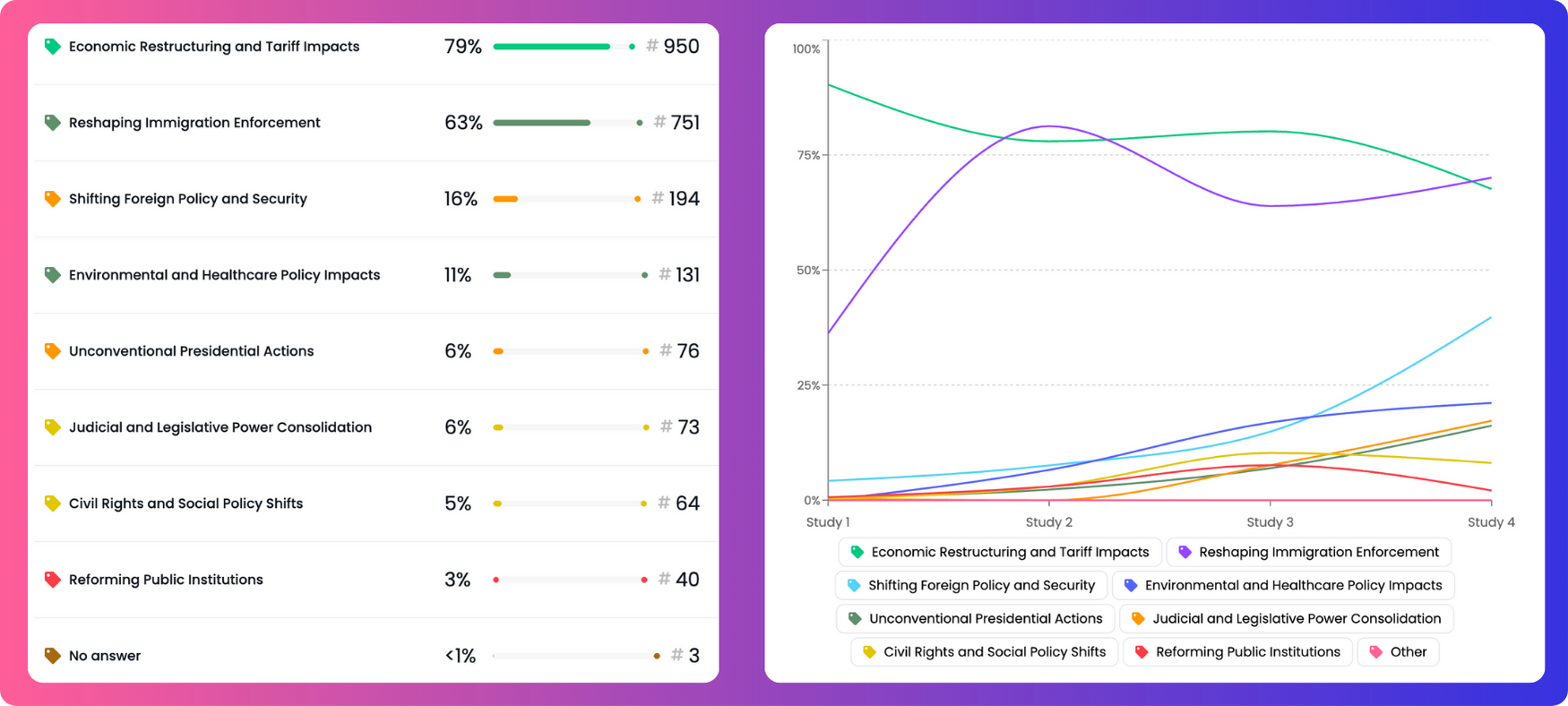
8 voter themes emerged, 2 stand out: when asked about the biggest actions or policies from recent weeks, voters surfaced 8 main themes. 2 stood out above all: economic restructuring and tariff impact (named by 79% of respondents), and reshaping immigration enforcement (named by the 63%). All priorities emerged directly from open responses - no pre-set codebook - thanks to Glaut’s AI-driven analysis.
84% completion rate: respondents stayed engaged, showing an improvement of 56% compared to survey equivalent
Faster turnaround, insights within hours: Glaut delivered fully analyzed results in hours, not weeks; dramatically faster than traditional qualitative studies, which often take several weeks from fieldwork to final report.
The Problem: why numbers alone aren’t enough
Political polling often stops at the numbers:
“Is the country moving in the right or wrong direction?”
“What’s the approval rating?”
The industry’s obsession with percentages turns public opinion into a spreadsheet, where nuance - the why behind the what - gets lost in translation. Traditional trackers are great at mapping trends. But when it comes to the real stories, motivations, and shifting priorities that shape voter sentiment, they fall short.
Glaut set out to answer this gap. Using AI-moderated interviews (AIMIs), we built the first qualitative tracker for U.S. politics.
Disclaimer: This demo project utilized samples balanced for age, gender, and ethnicity; however, results are not fully representative of the U.S. electorate. The findings should be interpreted as exploratory and illustrative rather than a statistically robust reflection of national public opinion.
Project design: the Qualitative U.S. Political Tracker
Structure: 4 monthly research waves, each with 300 respondents (1200 interviews total).
Sample: balanced by age, gender, ethnicity; not designed to match the national electorate on voting history.
Interview flow:
7 open-ended questions about government actions, the country’s mood, Trump’s priorities and performance.
Dynamic AI-moderation: Glaut adapted its follow-ups based on each participant’s unique responses.
Analysis approach:
Responses systematically coded via multi-level AI thematic tagging.
Priorities, narratives, and perceptions surfaced from interview verbatims. You can click and listen to real voter words, not just see a number.
Key findings and insights
1. Economic and immigration issues dominated
When asked about the biggest actions or policies from recent weeks, voters surfaced 8 organic themes in their own words. Two stood out by far:
Economic restructuring and tariff impact (79% of respondents)
Reshaping immigration enforcement (63% of respondents)
Other themes - such as social unity, national security, and climate change - were present but less prominent, highlighting the true priorities that emerged directly from voter voices, not from a pre-set list.
2. Narrative context adds meaning
Instead of a single “right/wrong direction” tally, Glaut’s AIMI approach pieced together sentiment from answers to several open questions. he resulting analysis revealed a predominance of negative feelings about America’s trajectory, providing richer narrative context than a simple yes/no measure.
Results from Glaut'software: themes & trend
How does AI-Moderated Interviews perform compared to traditional surveys?
Glaut’s platform not only matched the reach of traditional research, but significantly outperformed online static surveys in critical areas, according to two independent studies from Mannheim University and Human Highway.
Lexical Variety: The use of the AIMI modality led to an 8.55% increase in distinct lemmas (25.00 vs. 23.03), suggesting that participants activated a more varied vocabulary.*
Semantic cohesion in voice responses was more than double (+105%) that of text-only AIMI responses. This suggests that oral interaction reduces the "cognitive friction" typical of typing, allowing for a more natural and fluid expression of reasoning.*
Overall experience score: +6% (4.22 vs. 3.98). This difference was statistically significant (p = .02, d = 0.33).**
AIMI obtained a 0% of Gibberish Response rate, compared to the 10% within online static surveys.**
While our findings illuminate real voter narratives, this tracker was a prototype: its balanced (not representative) sample means results should be treated as exploratory. Still, the technology is now proven and ready to power more robust, fully representative studies in politics and beyond.
Why this matters
Glaut’s case is about moving political research toward methods that honor the complexity of public opinion. AIMIs enable organizations to:
Truly understand what drives sentiment change through authentic dialogue
Benefit from AI’s scale and analytical rigor without losing the human touch
Produce actionable insights that inform smarter policy, creative, and business decisions
Ready for research that actually listens?
Political research deserves tools that go deeper and work smarter. Glaut’s AI-moderated interviews set a new standard: scalable, human, insightful.
Want to see or hear real voter perspectives? Try the interview on Glaut. Experience the difference that next-generation qualitative research can make.
Lorem ipsum dolor sit amet, consectetur adipiscing elit, sed do eiusmod tempor incididunt ut labore et dolore magna aliqua. Ut enim ad minim veniam, quis nostrud exercitation ullamco laboris nisi ut aliquip ex ea commodo consequat. Duis aute irure dolor in reprehenderit in voluptate velit esse cillum dolore eu fugiat nulla pariatur.